
Services
Workshops & Training
PD is most useful when educators can connect ideas with their own classrooms and agree how those ideas will be put into practice. These offerings provide time to examine familiar challenges, question assumptions and develop approaches that colleagues can understand and apply. The short sessions introduce a focused area of learning; the extended workshops allow participants to discuss cases, practise techniques and develop resources for their setting.
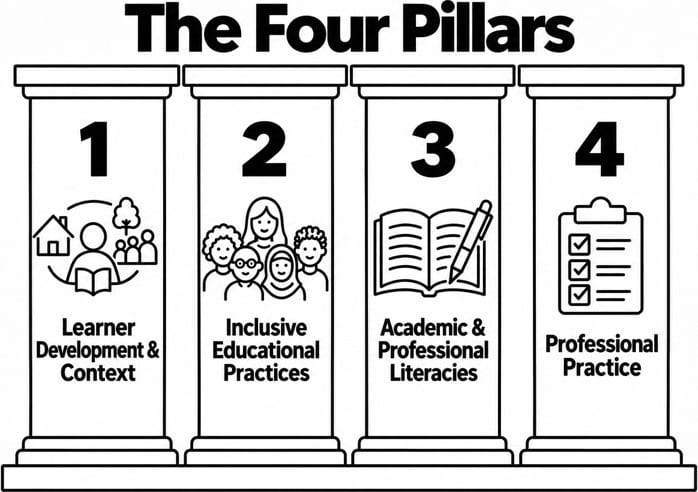
The four pillars define the scope of my professional learning work. Each offering sits within one pillar and can be selected independently or combined with others. Schools can use the series to develop a shared language around responsible writing, learner context, cultural inclusion and classroom expectations. The aim is to help staff leave with a clear next step and a practical way to review its use.
Short and extended delivery
Each workshop is available as a short 60-90 minutes introductory session or a long workshop lasting half a day to one day. The half-day version provides focused application; the full-day version adds extended practice, collaborative development and planning. Timings and breaks are agreed with the organising school.
Workshops can be designed for online or in-person delivery. Schools may select one topic or combine all four into a professional learning series. Examples, activities and expected outcomes are agreed in advance to reflect participants’ roles, experience and priorities.
Intended audience
Teachers, school leaders, learning support staff, academic coordinators, teacher educators and preservice teachers. The academic integrity workshop is particularly suited to secondary settings; the remaining workshops can be adapted across school phases.
1 Learner Development & Context
1.1 Human Ecology & Schooling
What becomes visible when we consider a learner’s classroom experience alongside relationships, school structures and wider conditions? Drawing on Bronfenbrenner’s ecological perspective, this workshop helps educators examine how learners’ experiences are shaped by interactions among family, peers, school, community and the broader social environment.
Participants explore connections between settings, influences that affect students indirectly and changes over time, including school transitions. Ecological thinking provides a framework for asking better questions about engagement, belonging and learning. The focus is on identifying barriers, existing supports and areas where teachers and schools can act.
- Describe the ecological systems surrounding a learner using accessible school-based examples.
- Map relationships and influences across home, classroom, school and community.
- Examine how transitions and connections between settings can affect participation.
- Separate observations from assumptions when discussing a learner’s circumstances.
- Identify feasible classroom actions and opportunities for coordination with colleagues or caregivers.
Introduces the ecological perspective through a school-based case. Participants construct a brief learner map, identify an influence they may have overlooked and select one practical response. The short version builds a shared language for discussing context.
Adds detailed ecological mapping, case analysis and collaborative planning. Participants examine how factors interact, identify missing information and distinguish actions within their role from those requiring wider coordination. They develop a plan for strengthening a relationship, improving a transition or reducing a barrier to participation.
The half-day version focuses on the core activities and an initial plan. The full-day version adds further case discussion, feedback on participant materials and time to develop and review resources for implementation.
- Which influences outside the classroom may be missing from our understanding of a learner?
- Where do home, school and community expectations connect or conflict?
- What can we change within our role, and where is wider coordination needed?
An ecological mapping template, a set of questions for case discussion and a draft plan for coordinated support.
Teachers, pastoral and learning support staff, year-level coordinators, school leaders and teacher educators. Participants may bring an anonymised case or a transition challenge. Activities respect confidentiality and avoid requiring disclosure of sensitive family information.
2 Inclusive Educational Practices
2.1 Cultural Diversity & Stereotyping
How do classroom language, resources and expectations communicate who belongs? This workshop examines how cultural assumptions and stereotypes can influence teaching, relationships and judgements about learners. Participants reflect on identity and intercultural understanding while considering diversity within cultural groups as well as differences between them.
The workshop distinguishes representation, inclusion and belonging: who is visible, who can participate and who feels accepted and valued. Participants examine the hidden curriculum, tokenistic approaches and the difference between equitable support and identical treatment. The purpose is to develop classroom practices that recognise learners without reducing them to cultural labels.
- Identify stereotyping and assumptions in classroom scenarios, resources and everyday language.
- Distinguish representation, participation and a sense of belonging.
- Examine how classroom routines and the hidden curriculum communicate expectations.
- Evaluate materials for narrow portrayals, omissions and tokenism.
- Plan culturally responsive adjustments that draw on learner perspectives and preserve meaningful learning expectations.
Introduces core concepts through examples of classroom language and representation. Participants analyse a short scenario or resource, reflect on an assumption and identify an adjustment to improve participation. The short version establishes a foundation for further school discussion.
Extends the work through scenario discussion, a resource review and collaborative redesign. Participants examine whose perspectives are included, consider how to respond to a stereotypical comment and adapt a lesson, classroom routine or communication. They plan how learner feedback could inform further changes.
The half-day version focuses on the core activities and an initial plan. The full-day version adds further case discussion, feedback on participant materials and time to develop and review resources for implementation.
- Whose perspectives are visible in our resources, and whose are missing?
- When might an apparently neutral expectation create a barrier to participation?
- How could we check whether learners feel included without assuming their experiences?
A resource review checklist, a revised classroom example and a practical plan for seeking learner perspectives.
Teachers across school phases, school leaders, EAL staff, learning support teams and teacher educators. Participants may bring a lesson, text, display or communication for review. Activities invite reflection without asking participants to speak on behalf of a cultural group.
3 Academic & Professional Literacies
3.1 Academic Integrity in Practice
How can teachers help students use sources responsibly while responding fairly to concerns about academic misconduct? This workshop examines the relationship between academic literacy, assessment expectations and integrity. Participants explore cheating behaviours, plagiarism, inappropriate collaboration and patchwriting, including the practice of assembling fragments from different sources. The emphasis is on explicit teaching, informed interpretation and proportionate responses.
Examples include reading Turnitin similarity reports, teaching paraphrasing and referencing, and discussing the permitted use and acknowledgement of generative AI. A similarity percentage is treated as a starting point for examining matched text, rather than a verdict on misconduct. Participants consider writing processes, task requirements and relevant institutional policies before drawing conclusions.
- Distinguish common forms of misconduct from difficulties with source use that require further investigation and teaching.
- Interpret matched passages in a similarity report alongside quotations, references and assessment requirements.
- Explain the differences between quotation, paraphrase, summary and patchwriting.
- Model techniques for integrating sources and applying a selected referencing convention.
- Plan preventive teaching and a fair response to an academic integrity concern.
Introduces common integrity concerns and the principles of reading similarity reports. Participants examine one anonymised writing example, practise improving a paraphrase and identify a change to their teaching of source use. The short version prioritises recognition and prevention.
Extends the introduction through comparative writing samples, anonymised similarity reports and discussion of assessment scenarios. Participants practise source integration, evaluate possible explanations for matched text and redesign task instructions or a teaching sequence. Discussion includes how to document concerns and follow the institution’s response process.
The half-day version focuses on the core activities and an initial plan. The full-day version adds further case discussion, feedback on participant materials and time to develop and review resources for implementation.
- What evidence would you examine before deciding that matched text indicates misconduct?
- How do students learn the difference between paraphrasing and patchwriting in your setting?
- Which task instructions could make source use and permitted assistance clearer?
A source-use checklist, a paraphrasing activity and a draft set of integrity expectations for an assessment task.
Secondary teachers, assessment coordinators and school leaders. Participants may bring an assessment task and the referencing convention used in their setting. No live Turnitin account is required; any student examples must be anonymised.
4 Professional Practice
4.1 Theory to Classroom Practice
How can staff establish a shared understanding of what is expected in every classroom? This workshop focuses on translating school expectations into everyday practice. Teachers examine essential routines, learning expectations and professional responsibilities, then clarify how those expectations can be communicated, taught and reinforced.
Being on the same page requires more than agreeing a list of rules. Participants identify what each expectation looks like in action, where teacher judgement remains appropriate and how support can be adapted for learners. The emphasis is on a manageable set of non-negotiables that staff can explain and apply, with clear distinctions between shared expectations and preferences.
- Identify clear, achievable classroom non-negotiables.
- Establish shared expectations for learning, behaviour and participation.
- Teach routines rather than assume students understand them.
- Communicate expectations consistently to students and colleagues.
- Review differences in interpretation so staff work from the same understanding.
Introduces non-negotiables and shared expectations through a classroom scenario. Participants identify priorities, clarify what an expectation looks like in practice and choose one routine to teach or review. The short version establishes a basis for staff discussion.
The half-day version uses classroom scenarios, a review of existing expectations and collaborative planning to develop agreed routines and consistent language. The full-day version adds rehearsal of explanations, comparison of staff interpretations and development of a plan for teaching, reinforcing and reviewing expectations. Participants consider reasonable adjustments and how to respond when expectations are not met.
- Which expectations must be shared across classrooms, and why?
- Would colleagues describe the same non-negotiable in the same way?
- How can we maintain a shared expectation while adjusting the support a learner needs?
A classroom expectations checklist, agreed descriptions of essential routines and a staff alignment action plan.
Teachers, school leaders, mentors, year-level teams and preservice teachers. Participants may bring existing classroom expectations or a routine that staff interpret differently. Examples can be adapted to the school phase and relevant policies.